When you design compact automation equipment, limited installation space can make reliable object detection difficult. A conventional sensor may not fit into narrow mounting positions, while inconsistent detection can affect production accuracy and equipment efficiency. An ultra-thin photoelectric sensor offers a practical solution by combining a compact structure with precise non-contact detection. However, size alone should not determine your choice. You also need to consider detection distance, response time, output type, light source, and installation requirements. HUAYIFENG's LS101-D100ND addresses these requirements with a fingertip-sized housing, 100mm detection distance, and 940nm infrared light. Understanding these specifications helps you determine whether this miniature sensor suits your automation equipment and production environment.
An ultra-thin photoelectric sensor is a compact detection device that uses light to identify the presence or movement of objects without physical contact. Its small housing allows installation in narrow spaces where conventional industrial sensors may be difficult to accommodate.
The LS101-D100ND from HUAYIFENG is a diffuse reflection photoelectric sensor designed for compact equipment and industrial automation applications.
Its main characteristics include:
⦁ Compact structure: Fingertip-sized housing for installation in confined spaces.
⦁ Non-contact detection: Detects opaque objects without requiring physical contact.
⦁ 100mm detection distance: Supports object detection across a defined working range.
⦁ High detection accuracy: Suitable for detecting small objects with a diameter greater than 4mm.
⦁ Adjustable sensitivity: Built-in sensitivity regulator allows you to fine-tune detection.
⦁ Flexible installation: Includes a standard 2-meter meander-resistant cable.
These features make the LS101-D100ND a practical option when your equipment requires a small sensor without sacrificing essential detection functions.
When evaluating a compact photoelectric sensor for automation, you should examine its optical performance, electrical specifications, and environmental compatibility.
Space restrictions are common in automated machinery, particularly when multiple sensors, actuators, and cables must share a limited mounting area.
The LS101-D100ND features an ultra-small and ultra-thin structure that fits into narrow installation positions. Its compact housing also gives equipment designers greater flexibility when arranging detection points.
Despite its small size, this infrared photoelectric sensor provides a detection distance of 100mm using diffuse reflection.
It operates with a 940nm infrared light source, allowing it to detect opaque objects with a diameter greater than 4mm under suitable installation conditions.
You can consider this detection method for:
⦁ Small object detection on conveyor systems.
⦁ Component presence detection in assembly equipment.
⦁ Workpiece positioning and monitoring.
⦁ Automated material handling equipment.
The LS101-D100ND has a response time of less than 2ms, supporting fast detection in automated processes.
It also includes a built-in sensitivity regulator. You can adjust the detection sensitivity during equipment commissioning to accommodate different object positions and operating conditions.
Electrical compatibility is another important factor when selecting an industrial photoelectric sensor.
The LS101-D100ND provides NPN output and supports a 12–24V DC power supply. Its rated load current is up to 100mA, while its residual voltage remains below 2V under the specified 100mA load condition.
Additional protection features include:
⦁ Surge protection.
⦁ Short-circuit protection.
⦁ Reverse-polarity protection.
These functions help protect the sensor during normal equipment operation.
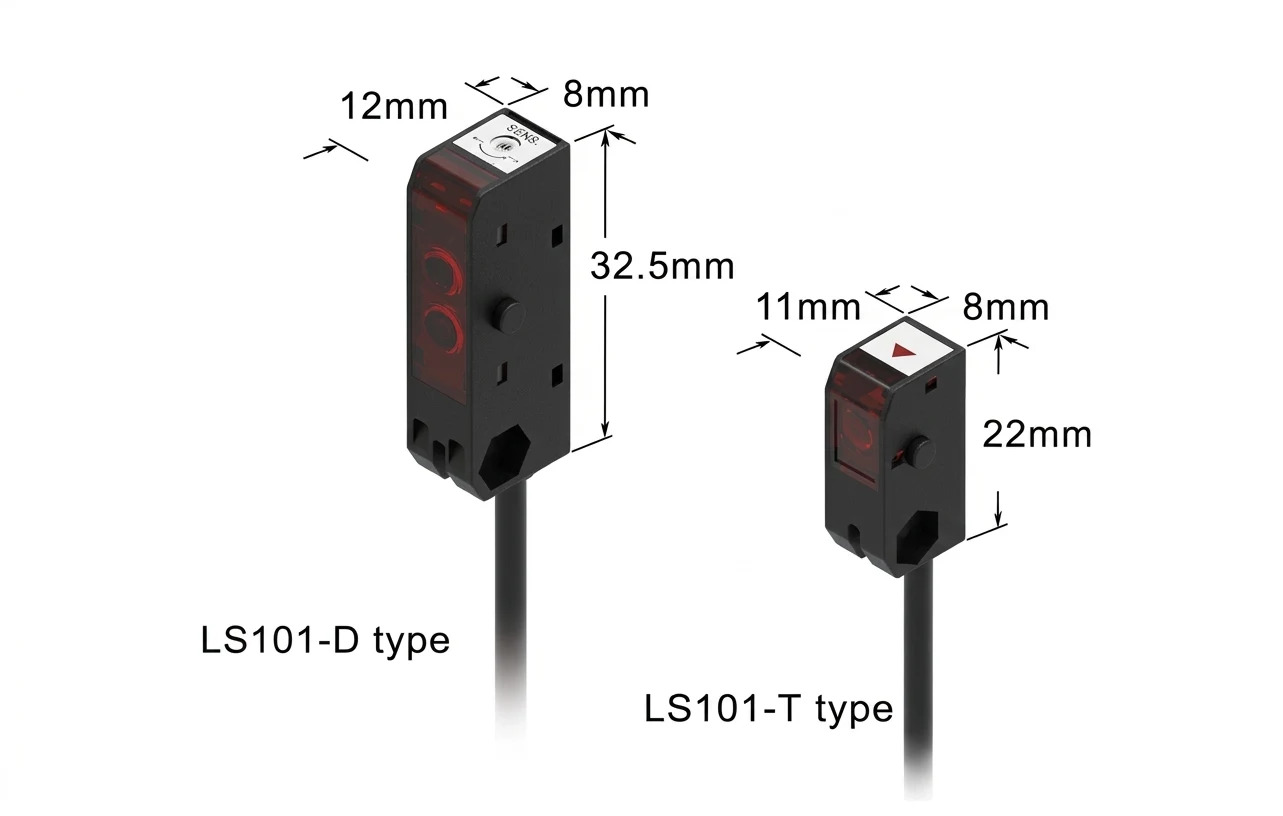
Before integrating a miniature photoelectric sensor into your equipment, compare its specifications with your control system and installation requirements.
| Parameter | LS101-D100ND Specification |
|---|---|
| Detection principle | Diffuse reflection |
| Light source | 940nm infrared |
| Detection distance | 100mm |
| Minimum detectable object | Opaque objects over 4mm in diameter |
| Output type | NPN |
| Response time | Less than 2ms |
| Supply voltage | 12–24V DC ±10% |
| Current consumption | Less than 25mA |
| Maximum load current | 100mA |
| Residual voltage | Below 2V |
| Output modes | Light ON / Dark ON |
| Cable length | 2 meters |
| Housing material | PC |
| Operating temperature | -25°C to +55°C |
| Operating humidity | 35% RH–85% RH |
The sensor also supports an ambient illumination tolerance of up to 4,000 lux for incandescent lighting and 30,000 lux for sunlight, according to the supplied specifications.
Different photoelectric detection methods suit different equipment layouts. Understanding their differences helps you select an appropriate sensor configuration.
| Comparison | Diffuse Reflection | Through-Beam |
|---|---|---|
| Detection principle | Detects light reflected from the object | Detects interruption of light between emitter and receiver |
| Installation | Sensor positioned on one side | Emitter and receiver positioned opposite each other |
| Object detection | Uses reflected light | Uses interrupted light |
| Installation requirements | No separate opposite-side receiver required | Requires alignment between two optical units |
| Typical consideration | Compact equipment and object presence detection | Applications requiring a separate optical detection path |
The LS101-D100ND uses diffuse reflection detection, making it suitable for applications where a compact installation and single-side sensor arrangement are important.
HUAYIFENG also lists the LS101-T1.5MNOD as a separate infrared model with a 1.5mm detection specification. You should compare the actual detection configuration and installation requirements before choosing between the models.
Choosing a miniature photoelectric sensor involves more than checking its physical dimensions. Follow these steps to evaluate its suitability for your equipment.
Step 1: Measure the available installation space.
Check the mounting position, surrounding components, and cable routing. Confirm that the sensor housing fits without interfering with moving mechanical parts.
Step 2: Determine the required detection distance.
Measure the distance between the sensor and the target object. For the LS101-D100ND, the specified detection distance is 100mm.
Step 3: Check the target object's characteristics.
Consider object size, material, opacity, and surface condition. The LS101-D100ND is specified for detecting opaque objects over 4mm in diameter.
Step 4: Verify electrical compatibility.
Confirm that your controller supports NPN output and that the power supply operates within the sensor's 12–24V DC range.
Step 5: Adjust sensitivity and test operation.
After installation, use the built-in sensitivity regulator to fine-tune detection. Test the sensor under actual operating conditions to check detection stability.
Founded in 2009, Shenzhen Huayifeng Technology Co., Ltd. integrates sensor research and development, manufacturing, sales, and application support.
The company provides standard and customized sensor solutions for automation equipment manufacturers, particularly in the new energy, semiconductor, and electronics industries.
HUAYIFENG's manufacturing and technical capabilities include:
⦁ Product range: Approximately 3,000 product models covering photoelectric switches, proximity switches, laser ranging, ultrasonic ranging, safety light curtains, and safety door locks.
⦁ Technical development: 100 core patents and accumulated experience in sensor technology.
⦁ Quality management: ISO 9001 quality management system certification.
⦁ Environmental management: ISO 14001 certification.
⦁ Occupational safety: ISO 45001 certification.
⦁ Market support: A domestic distribution network covering 34 provinces and municipalities, supported by 150 dealers and 18,000 users, according to company information.
The company also holds specialized patents and software copyrights related to photoelectric sensor calibration, optical fiber sensing, and background suppression laser sensing.
For equipment manufacturers, these capabilities provide a foundation for evaluating standard sensor products and discussing customized detection requirements.
The LS101-D100ND has a rated detection distance of 100mm using 940nm infrared diffuse reflection. Its minimum specified detectable object is an opaque object over 4mm in diameter.
Yes. The sensor uses NPN output and supports a 12–24V DC power supply. Its maximum load current is 100mA, making it important to verify compatibility with your controller before installation.
Yes. The compact housing of the LS101-D100ND is designed for narrow installation positions. However, you should still check the mounting dimensions, detection angle, target distance, and cable routing before finalizing your equipment design.
Selecting the right ultra-thin photoelectric sensor requires balancing installation space, detection performance, electrical compatibility, and operating conditions. HUAYIFENG's LS101-D100ND combines a fingertip-sized structure, 100mm infrared diffuse reflection detection, a response time below 2ms, and adjustable sensitivity. These specifications make it worth considering for compact automation equipment, small object detection, and industrial production systems. By matching the sensor's technical parameters with your actual application, you can make a more informed equipment design and purchasing decision.
Contact HUAYIFENG to discuss your detection requirements, product selection, and customized sensor solutions.