RFID electronic tag is a data carrier that is used for item identification, has an information storage mechanism, and can receive the electromagnetic field modulation signal of the reader and return the response signal. It is usually called an electronic tag, and can also be called a radio frequency card, a radio frequency tag, a radio frequency label, etc. It is the hardware main body of the RFID system together with the reader.
The basic components of RFID system include RFID electronic tags, readers, radio frequency antennas, and application software. It is an automatic identification system that uses radio frequency identification technology for data acquisition and transmission.
Under the trend of intelligent manufacturing, RFID, as a non-contact automatic identification technology, can automatically identify target objects and obtain relevant data through radio frequency signals. RFID implementation and deployment costs are low, and data collection and transmission methods are very convenient. Enterprises are paying more and more attention.
RFID electronic tag technology is a technology that uses radio waves for automatic identification and tracking. In the production process, it is necessary to use an RFID electronic tag reader to convert the design or image into an RFID electronic tag. RFID tags usually consist of a chip and an antenna. The chip stores tag information, and the antenna is used to receive and transmit signals. When the RFID tag passes by the reader, the reader will emit radio waves, which will be reflected by the RFID tag and transmit the information to the reader. The reader can read and write tag information for automatic identification and tracking. as shown in Fig.
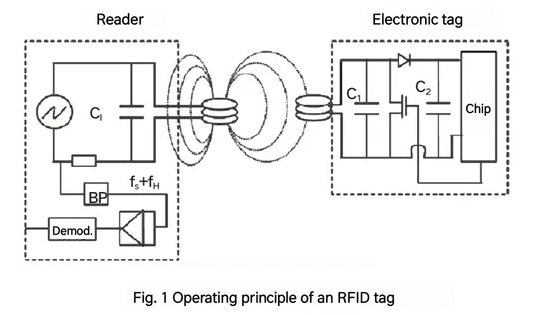
RFID tags can be divided into four types according to the frequency band: low frequency (LF), high frequency (HF), ultra high frequency (UHF) and microwave (MW).
The operating frequency range of low frequency (LF)RFID tags is 30kHz ~ 300kHz, and the typical operating frequencies are 125KHz and 133KHz. This type of RFID tag usually has a short identification distance, generally less than 1 meter. Due to its low frequency, low-frequency RFID tags perform well in anti-interference ability and adaptability, and are suitable for some data collection requirements. Scenes with low and harsh environmental requirements, such as pet identification, animal tracking, etc. The price of low-frequency RFID tags is relatively low, and the cost is relatively easy to accept.
The operating frequency range of high frequency (HF)RFID tags is 3MHz to 30MHz, and the typical application frequency in practical applications is 13.56MHz. Compared with low-frequency RFID tags, high-frequency RFID tags store more data and have a longer identification distance, generally less than 1.5 meters. High-frequency RFID tags are widely used in logistics, inventory management, access control and other fields. Due to their high frequency, the data transmission speed of high-frequency RFID tags is relatively fast, which is suitable for some scenarios that require frequent data exchange.
The operating frequency range of ultra-high frequency (UHF)RFID tags typically operates in the frequency range of 860MHz to 960MHz. UHF RFID tags have fast transmission speed, long reading distance, large storage capacity, and the maximum identification distance can reach more than 10 meters. It has high reading speed and large-scale tag reading ability. Therefore, UHF RFID tags are widely used in large-scale application scenarios such as retail, logistics and distribution, and vehicle identification.
Microwave (MW)RFID tags typically operate in the frequency range of 2.45GHz or 5.8GHz. Microwave RFID tags have a longer identification distance and higher data transmission speed, and are suitable for some scenarios that have higher requirements for data transmission speed and identification distance, such as intelligent transportation, intelligent manufacturing and other fields.
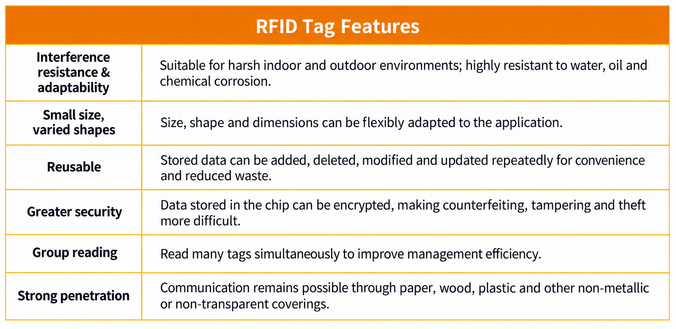
Can identify a single, very specific object, unlike bar codes, which can only identify one type of object; can read multiple objects at the same time, and bar codes can only be read one by one;
Using radio frequency, due to the penetration of radio frequency technology, data can be read through external materials, and bar codes must rely on laser or infrared to read information on the surface of the material medium. RFID tags can be operated in a non-contact manner without exposing the tag for scanning.
RFID electronic tags have the characteristics of waterproof, antimagnetic, and high temperature resistance that bar codes do not have. R has low environmental requirements and can work in various harsh environments. The tags are not easily damaged and do not affect reading.
It can identify data with high accuracy, speed and wide range, so it can be used for identification and reading on fast moving objects. At the same time, the tag data can be encrypted, the storage data capacity is larger, and the storage information can be changed freely.
Automation, intelligence, reduce manual operation. This is also RFID tags are called smart tags, and play an important role in intelligent construction, such as smart home, smart medical, intelligent transportation and other fields.
At present, RFID tags are widely used in production, logistics, transportation and other fields.
(1) Production line management. RFID electronic tags can easily and accurately record process information and process operation information to meet flexible production needs. The record of workers' work numbers, time, operation and quality inspection results can fully realize the traceability of production and avoid mistakes caused by human factors in the production process.
(2) Warehouse management. RFID electronic tags can effectively solve the information management of stored goods, and can understand the location and storage of goods in real time, which plays an important role in improving storage efficiency and guiding production.
(3) Management of valuables. RFID electronic tags can be used for anti-theft, settlement and after-sales guarantee of valuables such as cameras, video cameras, portable computers, CD walkman, jewelry, etc. Specialized shelf scanners scan goods in real time and get real-time cargo records.
(4) Management of books and rental products. The RFID electronic tag on the book can easily receive the book information, and no longer need to move the book when sorting the book, which improves the work efficiency and avoids the work error.
(5) product anti-counterfeiting. The product-specific RFID electronic tag can record all the information of the product from the source manufacturer to the sales terminal, the unique code in the electronic tag, the difficulty of counterfeiting the electronic tag, and the automatic detection characteristics of the electronic tag, so that the electronic tag has the function of product anti-counterfeiting and anti-theft. The use of RFID electronic tags on products can also play the role of brand protection, and can be widely used in the fields of identification such as drugs, access control and tickets.
With the application of RFID electronic tags more and more widely, RFID electronic tags will also develop in the following directions:
With the development of the printing industry, the quality requirements of printed matter are getting higher and higher. In the future, RFID electronic tags will also develop in the direction of high precision and generate higher quality printing layouts.
With the increasing demand for production efficiency, the production speed of RFID electronic tags is also required to be faster and faster. In the future, RFID electronic tags will develop in the direction of rapid development, further improving the speed and efficiency of production.
With the development of artificial intelligence technology, RFID electronic tags will develop in the direction of intelligence. In the future, artificial intelligence technology can be used to automatically identify, process and optimize designs or images and produce high-quality printed layouts. With the continuous upgrading and improvement of RFID technology, the production of RFID electronic tags will be more intelligent in the future, and a higher level of automation and intelligence can be achieved.
With the development of digital technology, RFID electronic tags will develop in the direction of digitalization. In the future, digital technology can be used to realize fully digital, automated and intelligent production processes.
With the progress of technology and the expansion of application, the production cost of RFID electronic tags will continue to decrease, and more and more enterprises and institutions begin to apply RFID technology.
With the continuous development of RFID technology, reading speed and data transmission speed continue to improve, can achieve more efficient item identification and tracking.
With the continuous development of RFID technology and the continuous expansion of application fields, RFID electronic tags will be applied to more fields and more applications in the future. In short, with the continuous progress of technology and the continuous expansion of application fields, RFID electronic tags will develop in the direction of low cost, high efficiency, intelligence and multi application, providing more efficient, more accurate and more intelligent support for the development of various fields.
RFID readers with different frequencies have unique advantages in their respective fields. Choosing the right frequency is very important to maximize the advantages of RFID technology. The wide application of RFID technology has brought intelligent changes to various industries, improved work efficiency and data transmission rate, and provided strong support for future digital transformation.